Artificial intelligence is changing the way businesses operate. What once seemed like technology for large corporations is now available to businesses of every size. Employees are using AI to write emails, summarize meetings, create reports, analyze data, develop marketing content, and even write computer code. These tools can save time, improve productivity, and help businesses work more efficiently than ever before.
While the benefits of AI are exciting, there is another side of the story that many business leaders are overlooking. The biggest risk isn’t the AI tools your company has approved. It’s the AI tools your employees may already be using without your knowledge.
This is happening more often than many organizations realize. An employee may use a public AI chatbot to help write a customer proposal. Another employee might upload financial information into an AI tool to build a spreadsheet or summarize a report. Someone in marketing may use AI to create content, while a software developer relies on AI to write code. None of these employees are trying to create problems. They are simply trying to do their jobs more efficiently.
Unfortunately, these everyday actions can introduce serious risks to the business.
When employees enter sensitive information into public AI tools, they may unknowingly expose customer data, company information, financial records, or intellectual property. They may also receive answers that sound correct but are actually inaccurate. If those answers are trusted without being reviewed, they can lead to poor business decisions, incorrect information being shared with customers, or costly mistakes.
Security professionals have a name for this growing issue: Shadow AI.
Shadow AI happens when employees begin using AI tools before the organization has established policies or approved their use. It is similar to Shadow IT, where employees install software or use technology without the knowledge of the IT department. The difference is that AI tools can process large amounts of business information in just seconds, making the potential impact even greater.
The challenge is that AI is advancing much faster than most organizations can keep up with. New tools are released almost every week, and many are free or inexpensive to use. Employees are naturally drawn to these tools because they help them complete tasks faster. In many cases, they do not realize they may be putting company data at risk.
This creates an important question for every business leader.
If someone asked you today which AI tools your employees are using, would you know the answer?
For many organizations, the honest answer is no.
That does not mean your business should avoid AI. In fact, companies that learn how to use AI responsibly will likely have a significant advantage over their competitors. AI can improve efficiency, reduce repetitive work, and allow employees to spend more time on activities that create value for customers.
The goal is not to stop innovation. The goal is to manage it responsibly.
This is where AI governance becomes important.
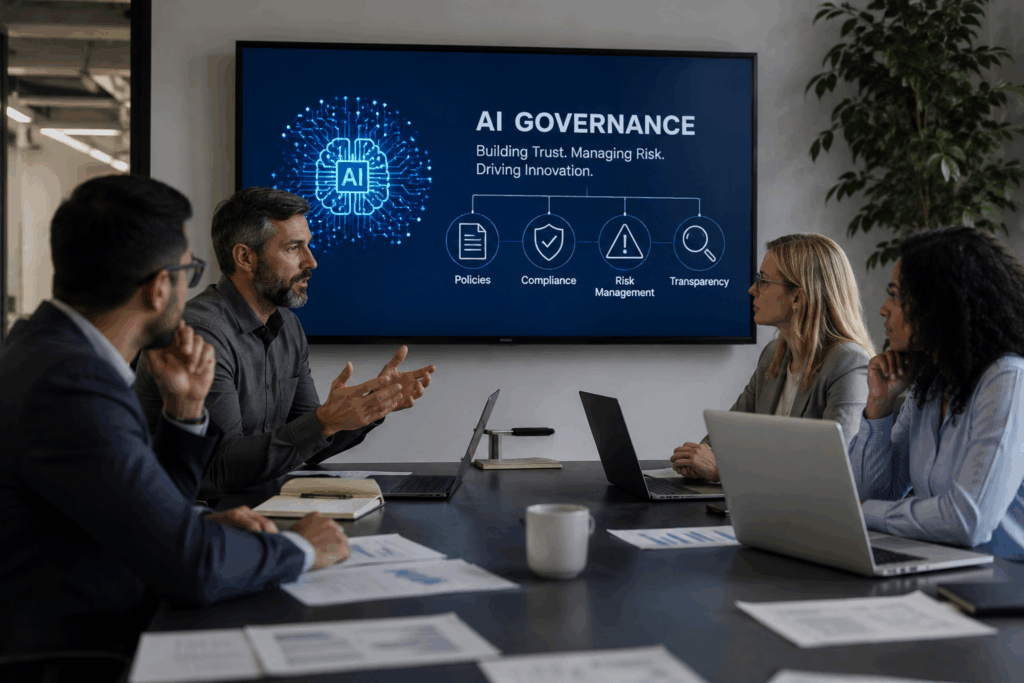
AI governance is simply a set of rules and guidelines that help employees understand how AI should be used within the organization. It identifies which AI tools are approved, what types of information can be entered into those tools, who is responsible for oversight, and how AI-related risks will be managed. A good governance program helps employees use AI with confidence while protecting the business from unnecessary risk.
Think about driving a car. Seatbelts and guardrails are not there to stop you from driving. They are there to help keep you safe while you reach your destination. AI governance works the same way. It allows your organization to take advantage of new technology while reducing the chance of costly mistakes.
Building an AI governance program does not have to be complicated. It starts by understanding which AI tools are already being used throughout the organization. From there, leadership can develop clear policies, provide employee training, and establish expectations for responsible AI use. As AI continues to evolve, those policies can grow and adapt with the business.
Organizations should also remember that AI governance is not just an IT responsibility. It involves leadership, human resources, legal, compliance, and every department that uses AI to support daily operations. Everyone has a role to play in protecting sensitive information and using AI responsibly.
The businesses that will benefit the most from artificial intelligence will not simply be the ones using the newest tools. They will be the organizations that build trust by using AI safely, responsibly, and with clear oversight. Customers, employees, and business partners all want to know that their information is being handled with care. A strong AI governance program helps demonstrate that commitment.
Artificial intelligence is here to stay, and its role in business will only continue to grow. Organizations that prepare now will be in a much stronger position to embrace new opportunities while avoiding unnecessary risk.
Ask yourself one simple question: Do you know how AI is being used across your organization, or are you simply hoping it is being used safely?
The answer may uncover one of the biggest hidden risks your business faces today.
At Triad InfoSec, we help organizations safely adopt emerging technologies by developing practical AI governance programs, strengthening cybersecurity, and reducing business risk. Responsible AI is not about slowing innovation. It is about creating the guardrails that allow your business to innovate with confidence while protecting your data, your employees, and your reputation.