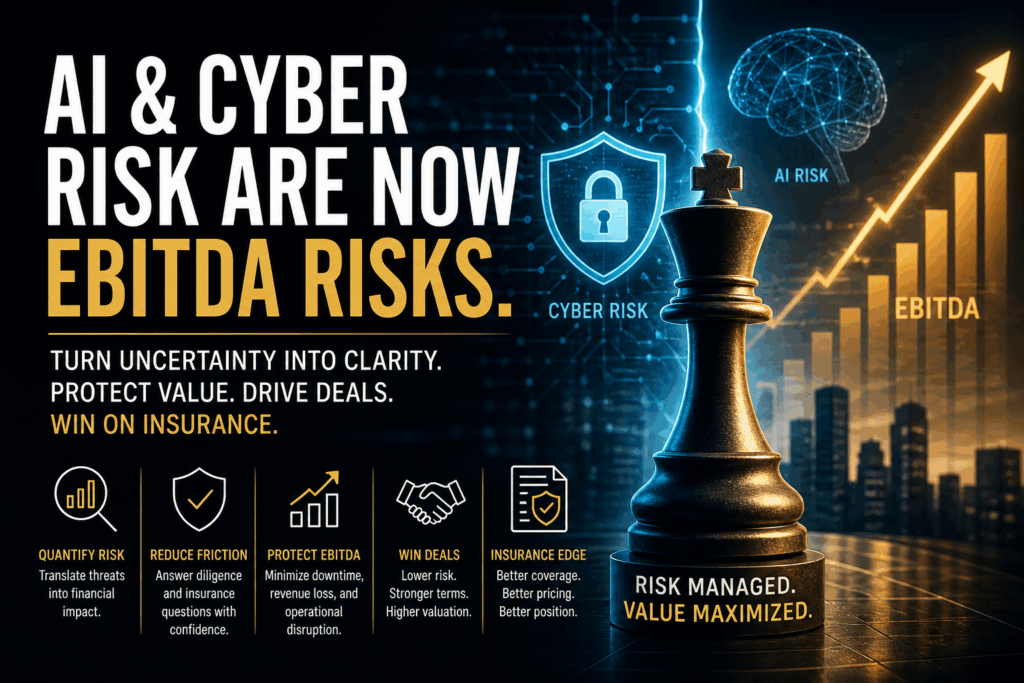
If you’re a CFO, COO, or part of a deal team, you already know how to look at a business. You focus on two things: what helps earnings grow and what could hurt them. What’s changed is that AI and cyber risk are no longer just “IT problems.” They’ve become business risks that directly affect EBITDA and, ultimately, company value. And the reality is most companies still aren’t prepared to explain these risks in a way that holds up under scrutiny.
The biggest issue isn’t simply that something might go wrong. The bigger problem is not knowing what the risk actually means in dollars. Deals rarely slow down just because a company experienced an incident. They slow down because the company can’t clearly explain what could happen, how large the impact might be, and what controls are in place to prevent it. When those answers are vague, buyers get cautious. Insurers start asking tougher questions and raising prices. Leadership ends up reacting under pressure instead of planning ahead. The result is delays, stress, and, in many cases, reduced leverage or lower valuation.
Business has changed because everything now runs on data, systems, and speed. Even a small disruption can cause real financial damage. Systems go down and billing stalls. Customers can’t get service. Revenue is delayed or lost, and collections slow behind it. At the same time, cyber insurance has become less forgiving. Carriers want proof, not promises. If you can’t clearly show what you do, how consistently you do it, and how you’ll respond when something goes wrong, you may pay more, or end up with less coverage than you assumed you had.
AI adds a second layer to the same problem. It’s spreading quickly across teams in marketing, sales, HR, finance, and customer support, often without clear rules. That creates risk in subtle but expensive ways: sensitive data gets shared unintentionally, incorrect outputs get trusted, and customer or vendor agreements get violated without anyone realizing it. None of this means AI is bad. It just means it needs basic guardrails, like any powerful tool that can materially impact operations, reputation, and financial performance.
This is where a better approach comes in. Instead of treating AI and cyber risk as technical issues, they need to be treated as financial ones. That means turning fuzzy concerns into measurable outcomes, so leaders can make clear decisions instead of guessing. IronImpact supports this shift by modeling risk in financial terms. Rather than debating hypotheticals, teams can see what a real scenario could cost. If a critical system is down for two days, what happens to revenue timing, cash flow, collections, customer retention, and operating efficiency? When you can quantify impact, finance can prioritize what matters, communicate it cleanly to leadership, and tie risk reduction to real business outcomes.
IronExit applies the same clarity to transactions. In deals, uncertainty becomes leverage for the buyer. If your company can’t present crisp, confident answers, diligence takes longer and terms can get worse. Preparing ahead of time changes that dynamic. IronExit helps organize the information buyers and lenders will ask for, surfaces risks early while there’s still time to address them, and helps you tell a clean story that reduces friction. The outcome is simpler: faster diligence, fewer surprises, and a stronger position at the table.
Insurance readiness solves another common pain point, companies thinking they’re covered until renewal proves otherwise. Insurers have tightened requirements, and their underwriting questions increasingly mirror diligence questions: what’s protected, how it’s controlled, and how you can prove it. By aligning your documentation and practices with what insurers actually expect, you walk into renewal from a position of strength. That can mean better pricing, better coverage, and fewer unpleasant surprises when it matters most.
AI risk scoring makes hidden exposure visible. Many leaders know AI is being used, but they don’t know where, by whom, and with what data. A simple scoring approach clarifies how AI is deployed across the business, what sensitive information touches those tools, and where the highest-risk gaps exist. It also gives leadership a practical way to measure improvement over time, instead of relying on assumptions.
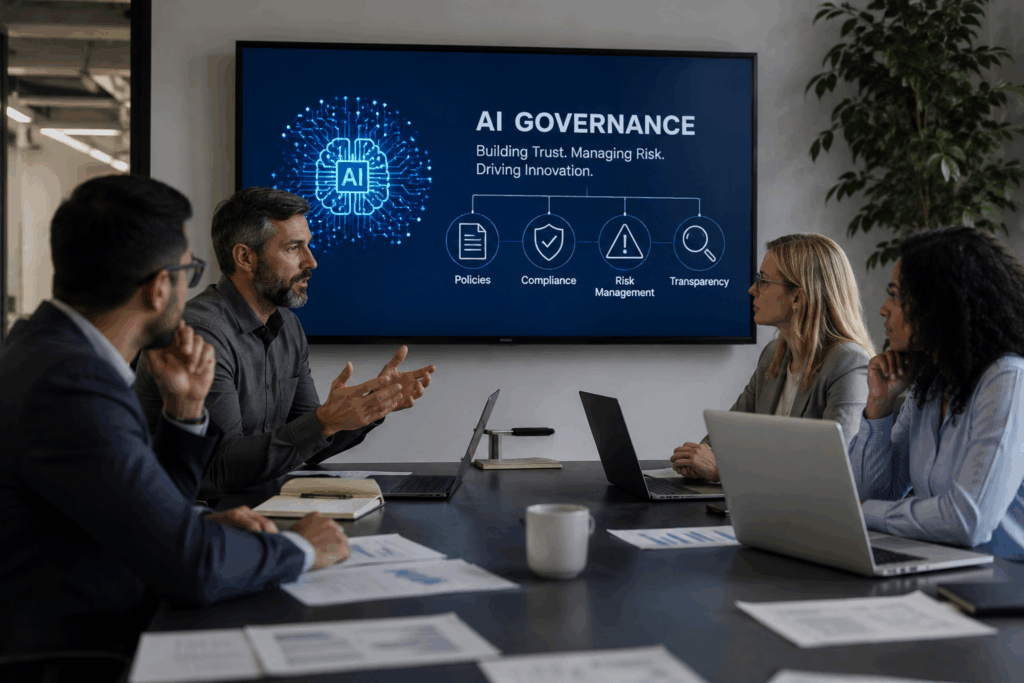
AI governance and vCISO support then bring structure without slowing the business down. Good governance isn’t heavy or bureaucratic, it’s simple and specific. It answers practical questions like which tools are allowed, what data should never be shared, and when human review is required. A vCISO helps connect those rules to business goals, turning scattered efforts into a coherent plan with accountability, measurable progress, and clear ownership across teams.
Across all of this, the goal is straightforward. Unmanaged risk creates uncertainty. Uncertainty lowers confidence. And lower confidence shows up in valuation, insurance outcomes, and growth. But when risk is measured and managed, it becomes an advantage. You move faster in deals because you reduce friction. You get better insurance results because you can prove what you do. You make better decisions because you’re not guessing about impact, you’re working from numbers.
Finance is now at the center of this shift. It’s the function best positioned to translate risk into dollars, uncertainty into clarity, and choices into outcomes. And if you want to start this quarter, you can keep it simple: first, quantify your key AI and cyber risks in financial terms. Next, make sure you can answer deal and insurance questions clearly and consistently. Then, put basic AI rules in place so teams can move fast without making avoidable mistakes.
This isn’t just about being more secure. It’s about being more prepared, more trusted, and more valuable as a business.